Economics in Art/Humanities: What the Programme Involves and What Students Study
Contents
Economics is a programme concerned with how individuals, businesses, governments and societies make choices about the use of limited resources. It examines issues such as production, consumption, markets, income, employment, prices and economic development.
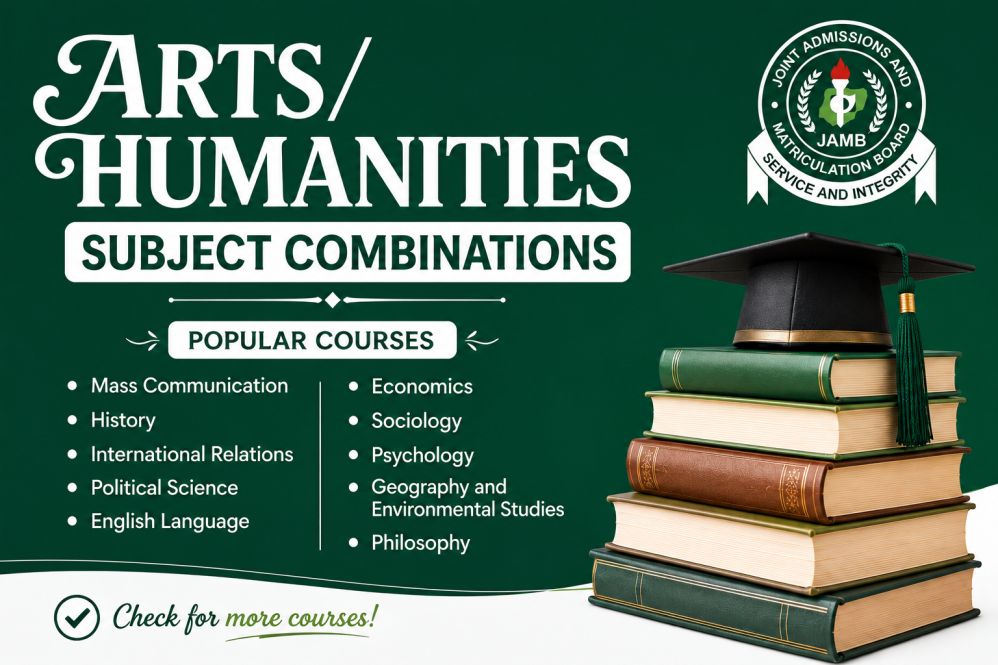
For candidates using the JAMB admission information, one important point is the academic grouping. In the supplied JAMB brochure, Economics appears under Arts/Humanities and is listed among the programmes in the Faculty/School/College of Arts section.
What Do Students Study in Economics?
Economics exposes students to theories and principles used to understand how economic activities work. The programme generally involves both conceptual study and the use of analytical methods to examine economic problems.
Students may encounter areas such as:
- Microeconomics
- Macroeconomics
- Economic theory
- Money and banking
- Public finance
- International economics
- Development economics
- Labour economics
- Agricultural economics
- Econometrics
- Economic policy
- Statistics and quantitative analysis
Understanding the Two Broad Sides of Economics
Microeconomics looks at smaller units of the economy, including consumers, households and individual businesses. Students learn how factors such as prices, demand, supply, costs and competition influence decisions.
Macroeconomics takes a wider view. It deals with issues affecting an economy as a whole, including national income, inflation, unemployment, economic growth and government economic policies.
Economics and Real-World Problems
One of the interesting features of Economics is its connection with everyday economic decisions. Questions about rising prices, unemployment, taxation, interest rates, government spending, international trade and economic growth can all be examined using economic ideas.
This means that students are not only introduced to theories but also learn how economic concepts can be applied when analysing real situations.
Skills Economics Students Can Develop
The programme can help students develop analytical and quantitative abilities. Depending on the courses and training they receive, students may build skills in:
- Economic analysis
- Critical thinking
- Problem solving
- Quantitative reasoning
- Research
- Data interpretation
- Report writing
- Policy analysis
Who May Enjoy Studying Economics?
Economics may suit students who are interested in understanding how markets, businesses, governments and economies operate. A willingness to work with figures and analyse information can also be useful because Economics may involve mathematics, statistics and quantitative methods.
Economics as an Art/Humanities Course in the Brochure
Candidates should not assume that the academic grouping of a course is identical everywhere simply because of how the subject is commonly described. For this admission-content series, the JAMB brochure supplied for the course places Economics within the Arts/Humanities grouping.
Admission conditions should therefore be checked against the exact institution and course entry rather than relying on a general faculty assumption.
What Candidates Should Keep in Mind
Economics can be a good choice for a student who wants to combine the study of economic issues with analytical and quantitative skills. However, candidates should also pay attention to the Mathematics requirement contained in the admission information for the course.
For further information about the admission conditions, candidates can consult the document provided below.

UTME2027 Editorial Team
The UTME2027 Editorial Team publishes accurate, timely and well-researched JAMB news, admission updates, CBT preparation guides and official educational information for Nigerian students. Every article is reviewed before publication to ensure accuracy and clarity.